Sweetening iced tea sounds simple until you try to stir granulated sugar into a cold glass and watch it sink to the bottom in a useless pile. The truth is that sweetener choice matters more in iced tea than in almost any other drink — not just for sweetness level, but for flavour, texture, and how well it actually dissolves.
Here is a thorough look at every common sweetener, how it behaves in cold tea, and when to use each one.
Why Cold Tea Is Different
Hot tea dissolves sugar instantly. Cold tea does not. This is the fundamental challenge of sweetening iced tea: most solid sweeteners require heat to dissolve properly, and adding them to a cold drink results in uneven sweetness, gritty texture, or sweetener pooling at the bottom of the glass.
The solution is either to sweeten while the tea is still hot, or to use a liquid sweetener that dissolves at any temperature. Both approaches work — the right choice depends on your workflow and the flavour profile you want.
Simple Syrup: The Gold Standard
Simple syrup is the most practical sweetener for iced tea, full stop. Made by dissolving equal parts sugar and water over heat, it's a liquid at room temperature and dissolves instantly in cold drinks.
How to make it: Combine 1 cup white sugar and 1 cup water in a small saucepan. Heat over medium, stirring until the sugar fully dissolves — this takes about 3–4 minutes. Do not boil. Let cool, then store in a sealed jar in the fridge for up to 4 weeks.
Flavour: Neutral. Simple syrup adds sweetness without changing the flavour of the tea, which makes it ideal for delicate teas like white tea, green tea, and floral herbals where you want the tea to be the star.
Rich simple syrup: Use a 2:1 ratio of sugar to water for a thicker, more intensely sweet syrup. You use less of it, and it has a slightly more rounded, less watery sweetness.
Variations: Simple syrup is the base for endless flavoured syrups — lavender, mint, ginger, hibiscus, cinnamon, vanilla. These are some of the most useful things you can have in your fridge for elevating iced tea quickly.
White Sugar (Granulated)
The most common sweetener, but not the most practical for cold drinks.
Dissolving: Granulated sugar dissolves poorly in cold liquid. If you add it directly to a cold glass, most of it will sink and not dissolve. The workaround is to add sugar while the tea is still hot and stir until fully dissolved before chilling.
Flavour: Clean and neutral. White sugar lets the tea flavour come through without adding anything of its own.
Best for: Sweet tea, where you're sweetening a hot concentrate before chilling. Not recommended for adding to cold drinks at the table.
Brown Sugar
Brown sugar contains molasses, which gives it a warm, caramel-like depth that pairs beautifully with black tea, chai, and spiced iced teas.
Dissolving: Same challenge as white sugar — dissolves best in hot liquid. Make a brown sugar simple syrup for cold drinks.
Flavour: Warm, molasses-forward, slightly complex. Dark brown sugar has more molasses than light brown sugar and a more pronounced flavour. This is a feature, not a bug — brown sugar sweet tea has a depth that white sugar can't replicate.
Best for: Sweet tea, spiced teas, chai iced tea, any black tea where you want a richer, more complex sweetness.
Honey
Honey is one of the most popular natural sweeteners for iced tea, and for good reason — it adds flavour complexity that sugar simply can't match.
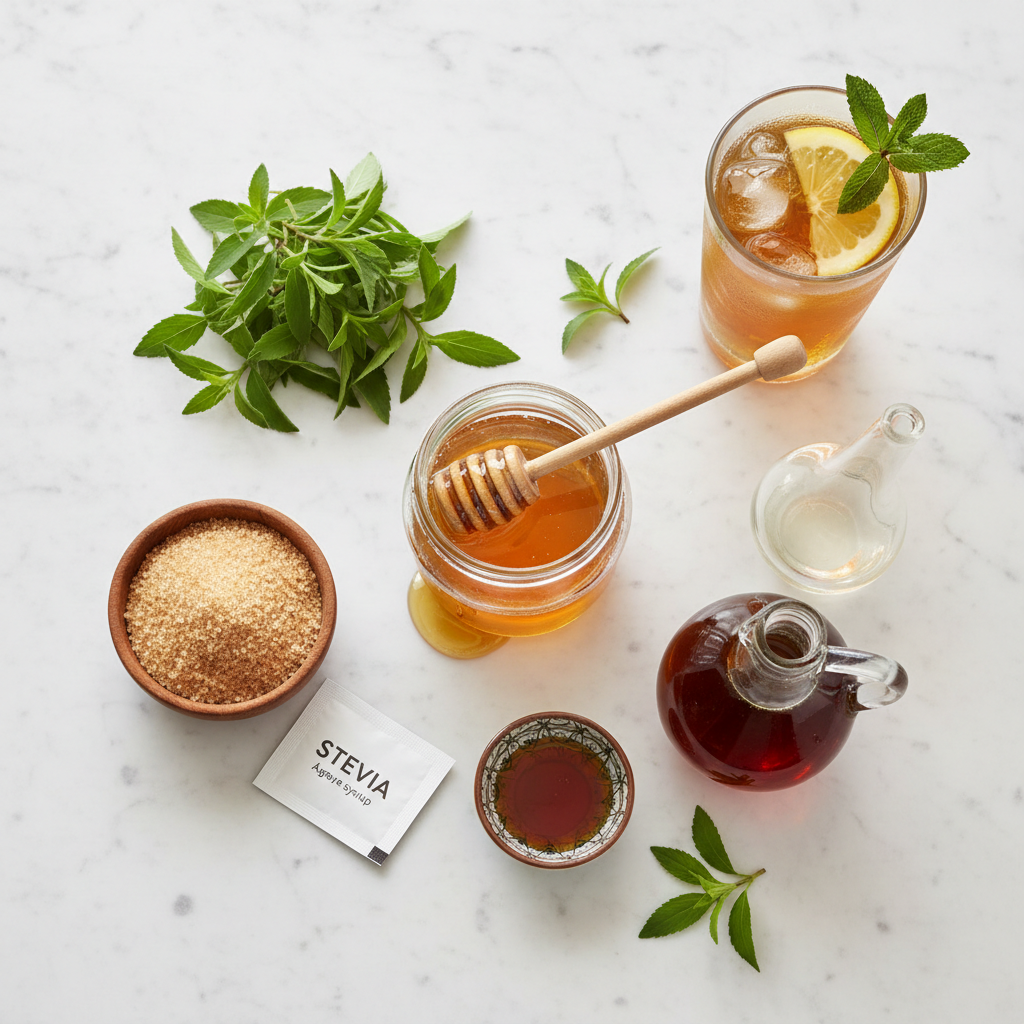
Dissolving: Honey dissolves reasonably well in cold liquid if you stir vigorously, but it's much easier to use honey simple syrup (equal parts honey and warm water, stirred until combined). The syrup pours easily and dissolves instantly.
Flavour: Varies significantly by type. Clover honey is mild and floral. Buckwheat honey is dark and robust. Wildflower honey is complex and variable. Manuka honey has a distinctive medicinal note. Choose your honey based on the tea — mild honeys for delicate teas, robust honeys for strong black teas.
Best for: Herbal teas, chamomile, green tea, lemon iced tea. Honey and lemon is a classic combination for good reason.
Note: Honey is sweeter than sugar by volume, so use about 25–30% less than you would sugar.
Agave Nectar
Agave nectar has become popular as a "natural" sweetener, and it does have some practical advantages for iced tea.
Dissolving: Agave dissolves easily in cold liquid — better than honey, almost as well as simple syrup. This is its main practical advantage.
Flavour: Light agave has a mild, slightly neutral sweetness with a faint caramel note. Dark agave has a more pronounced, almost maple-like flavour. Both are less flavourful than honey.
Sweetness: Agave is about 1.5 times sweeter than sugar, so use less.
Best for: Any iced tea where you want easy cold-dissolving without the strong flavour of honey. Good for green teas and light herbals.
Maple Syrup
Maple syrup is an underused sweetener for iced tea, particularly in Canada where it's abundant and high quality.
Dissolving: Dissolves well in cold liquid, especially lighter grades (Golden or Amber). Darker grades are thicker and may need a brief stir.
Flavour: Unmistakably maple — warm, woody, slightly caramel. This is a strong flavour that will come through in the tea. It pairs exceptionally well with black tea, rooibos, and spiced teas. It's less suited to delicate greens or florals where you don't want the maple to dominate.
Best for: Black tea, rooibos, chai, spiced iced teas. Particularly good in autumn-inspired blends.
Stevia
Stevia is a natural zero-calorie sweetener derived from the stevia plant. It's the most popular sugar-free option for iced tea.
Dissolving: Liquid stevia dissolves instantly in cold drinks. Powdered stevia dissolves well with stirring.
Flavour: This is where stevia divides people. It has a distinctive aftertaste — often described as liquorice-like or slightly bitter — that some people find unpleasant. The intensity of the aftertaste varies by brand and processing method. Some people are more sensitive to it than others.
Sweetness: Stevia is 200–300 times sweeter than sugar. Use very small amounts — a few drops of liquid stevia is typically enough for a full glass.
Best for: Sugar-free iced tea where you want zero calories. Works best in strongly flavoured teas (black tea, hibiscus, chai) where the tea flavour can mask the aftertaste.
Monk Fruit Sweetener
Monk fruit (luo han guo) is a natural zero-calorie sweetener that many people find more pleasant than stevia.
Dissolving: Liquid monk fruit dissolves instantly. Granulated monk fruit blends dissolve reasonably well in cold liquid.
Flavour: Cleaner than stevia with less aftertaste. Some people detect a faint fruity note, but most find it quite neutral. It's generally considered the best-tasting zero-calorie sweetener available.
Sweetness: 150–200 times sweeter than sugar. Use sparingly.
Best for: Sugar-free iced tea where you want minimal aftertaste. A good choice for anyone who finds stevia unpleasant.
Coconut Sugar
Coconut sugar is made from the sap of coconut palm flowers. It has a lower glycaemic index than white sugar and a distinctive flavour.
Dissolving: Dissolves poorly in cold liquid. Make a coconut sugar simple syrup for best results.
Flavour: Rich, caramel-like, with a hint of butterscotch. Similar to brown sugar but with a slightly more complex, less molasses-forward profile.
Best for: Black tea, rooibos, chai, any tea where you want a warm, caramel sweetness. A good alternative to brown sugar for people who prefer a slightly different flavour profile.
Raw Cane Sugar (Turbinado / Demerara)
These minimally processed sugars retain some molasses and have a slightly more complex flavour than white sugar.
Dissolving: Same challenge as granulated sugar — best added to hot liquid. Make a syrup for cold drinks.
Flavour: Slightly more complex than white sugar, with a faint molasses note. Less pronounced than brown sugar.
Best for: Sweet tea, black tea. A good middle ground between white sugar and brown sugar.
Practical Sweetening Strategies
For a pitcher of sweet tea: Sweeten while hot. Add your sweetener to the hot tea concentrate before adding cold water. This ensures complete dissolution and even sweetness throughout.
For individual cold glasses: Use simple syrup, liquid stevia, liquid monk fruit, or agave. These dissolve in cold liquid without stirring problems.
For flavour complexity: Use honey, maple syrup, or brown sugar syrup. These add their own flavour notes that complement the tea.
For zero calories: Liquid monk fruit is the cleanest option. Liquid stevia works well if you don't mind the aftertaste.
For entertaining: Make a flavoured simple syrup (lavender, mint, ginger) and set it out alongside the iced tea. Guests can sweeten to their own preference and the syrup adds an element of customisation that people love.
The Bottom Line
Simple syrup is the most practical all-purpose sweetener for iced tea — neutral, easy to use, and perfectly soluble in cold drinks. Honey adds flavour complexity that's worth exploring, especially for herbal and green teas. Brown sugar and maple syrup are excellent for black teas and spiced blends. For zero-calorie options, liquid monk fruit is the cleanest choice.
The worst approach is adding granulated sugar directly to a cold glass and hoping for the best. Make a syrup, sweeten while hot, or use a liquid sweetener — and your iced tea will be better for it every time.
Explore Topics
Written by
Steep & Chill
Content creator and writer sharing insights and stories.