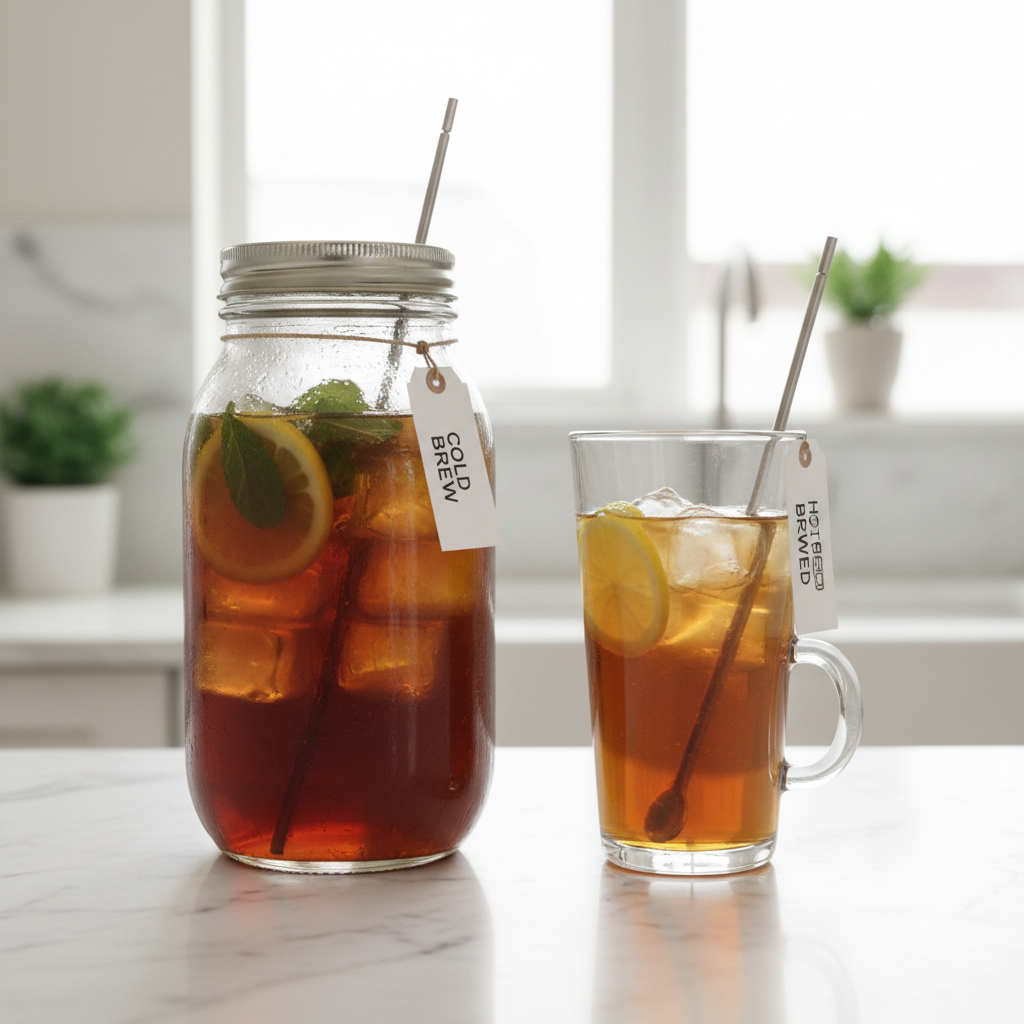
Steep time is the single most controllable variable in iced tea brewing. Get it right and you unlock the full flavour potential of your tea. Get it wrong — even slightly — and you end up with either a thin, watery brew or a bitter, astringent one that no amount of sweetener can fix.
The problem is that most brewing guides give you a single number — "steep for 3–5 minutes" — without explaining why, or how to adjust based on your specific tea, water temperature, and intended use. This guide fixes that.
Why Steep Time Matters More Than You Think
Tea leaves contain hundreds of flavour compounds that extract at different rates. The process is not linear — it's a race between the compounds you want (sweet amino acids, aromatic oils, balanced tannins) and the compounds you don't want (harsh tannins, bitter catechins, astringent gallic acid).
In the first minute or two of steeping, the desirable compounds — particularly L-theanine and aromatic volatiles — extract quickly. As steeping continues, tannins and catechins continue to accumulate. The goal is to stop steeping at the point where you have maximum desirable compounds and minimum bitterness.
That point is different for every tea type.
The Variables That Affect Steep Time
Before the times, understand what changes the equation:
Water temperature — Higher temperature = faster extraction of all compounds. Lower temperature = slower, more selective extraction. This is why green tea steeped at 95°C tastes bitter but the same tea at 75°C tastes sweet.
Leaf-to-water ratio — More tea = faster extraction and stronger flavour. If you use more tea than recommended, reduce steep time proportionally.
Leaf grade and cut — Finely cut leaves (like CTC black tea) have more surface area and extract faster than whole leaves. Fannings and dust (used in most tea bags) extract even faster. Whole-leaf loose tea extracts more slowly and requires longer steep times.
Water quality — Hard water (high mineral content) extracts tannins more aggressively and can make tea taste harsher. Soft or filtered water produces cleaner, more balanced flavour.
Intended use — Tea for iced drinks should be brewed stronger than tea for hot drinking, because ice dilution will reduce the concentration by 30–50%.
Steep Times by Tea Type
Black Tea
Hot brew for iced tea:
- Temperature: 95°C (203°F) — near boiling
- Steep time: 4–5 minutes for standard iced tea; 5–6 minutes for sweet tea (which needs a bolder base to stand up to sugar)
- Leaf ratio: 2–3g per 250ml (roughly 1 heaped tsp per cup)
- Warning: Beyond 6 minutes, black tea becomes noticeably bitter and astringent. Set a timer.
Cold brew:
- Temperature: 4°C (refrigerator cold)
- Steep time: 10–14 hours
- Leaf ratio: 3–4g per 250ml (slightly more than hot brew to compensate for lower extraction efficiency)
- Note: Cold brew black tea is very forgiving — an extra hour or two won't ruin it. But beyond 16 hours, even cold brew can develop slight bitterness.
Best loose-leaf varieties for iced tea: Assam (bold, malty), Ceylon (bright, citrusy), Darjeeling second flush (muscatel notes), Keemun (smoky, complex).
Green Tea
Green tea is the most temperature-sensitive tea type. It contains high concentrations of catechins that extract rapidly at high temperatures — producing bitterness that many people mistakenly attribute to green tea itself, rather than incorrect brewing.
Hot brew for iced tea:
- Temperature: 70–75°C (158–167°F) — significantly below boiling
- Steep time: 1.5–2 minutes maximum
- Leaf ratio: 2g per 250ml
- Critical: Never use boiling water on green tea. The catechins extract so rapidly that even 30 extra seconds at 95°C can ruin the cup.
Cold brew (strongly recommended for green tea):
- Temperature: 4°C
- Steep time: 6–10 hours
- Leaf ratio: 3g per 250ml
- Note: Cold brew is the preferred method for green tea. It produces a naturally sweet, smooth brew with minimal bitterness — and it's nearly impossible to over-steep.
Best varieties for iced tea: Sencha (grassy, fresh), Gyokuro (sweet, umami-rich — exceptional cold brew), Dragonwell/Longjing (nutty, smooth), Genmaicha (toasty, mild).
White Tea
White tea is the most delicate of all tea types. It's minimally processed — just withered and dried — which preserves its subtle floral and honey notes. It's also the most forgiving to steep.
Hot brew for iced tea:
- Temperature: 75–80°C (167–176°F)
- Steep time: 3–4 minutes
- Leaf ratio: 3–4g per 250ml (white tea is bulky — you need more by volume)
- Note: White tea can actually handle slightly longer steep times than green tea without turning bitter, because it contains lower catechin concentrations.
Cold brew (highly recommended):
- Temperature: 4°C
- Steep time: 8–12 hours
- Leaf ratio: 4–5g per 250ml
- Note: Cold brew white tea is extraordinarily delicate and beautiful — pale gold, subtly sweet, with floral notes that hot brewing can't fully preserve.
Best varieties for iced tea: Silver Needle (Bai Hao Yinzhen) — the premium choice; White Peony (Bai Mu Dan) — more affordable with similar character.
Oolong Tea
Oolong occupies the spectrum between green and black tea — partially oxidized, with flavour profiles ranging from floral and light (closer to green) to rich and roasted (closer to black). Steep times vary accordingly.
Hot brew for iced tea:
- Temperature: 85–90°C (185–194°F)
- Steep time: 3–4 minutes for light oolongs; 4–5 minutes for dark/roasted oolongs
- Leaf ratio: 3g per 250ml
- Note: High-quality oolongs can be re-steeped 2–3 times. Each subsequent steep reveals different flavour layers.
Cold brew:
- Temperature: 4°C
- Steep time: 10–14 hours
- Leaf ratio: 4g per 250ml
- Note: Cold brew oolong is exceptional — the complex, layered flavours emerge gradually and produce a brew with remarkable depth.
Best varieties for iced tea: Tie Guan Yin (floral, orchid-like), Dong Ding (roasted, caramel notes), Da Hong Pao (rich, mineral, complex).
Herbal Teas
Herbal teas (technically tisanes — they contain no Camellia sinensis) are the most forgiving category. Most herbal ingredients don't contain tannins, so over-steeping rarely produces bitterness.
Hot brew for iced tea:
- Temperature: 95–100°C (203–212°F) — full boiling water is fine for most herbals
- Steep times by type:
- Hibiscus: 10–15 minutes (needs extended time to release anthocyanins)
- Chamomile: 5–7 minutes
- Peppermint: 5–7 minutes
- Rooibos: 5–8 minutes
- Lemon verbena: 5–7 minutes
- Ginger: 10–15 minutes (or simmer for 5 minutes for maximum intensity)
- Lavender: 3–5 minutes (over-steeping can make it soapy)
Cold brew:
- Temperature: 4°C
- Steep times: Most herbals need 12–16 hours cold — longer than tea because they lack the enzymatic activity that speeds extraction in Camellia sinensis leaves.
- Exception: Peppermint cold brews in 8–10 hours; hibiscus needs 14–18 hours.
Iced Tea Concentrate
If you're making a concentrate to dilute with water or mix into cocktails, adjust as follows:
- Use 3–4× the normal leaf quantity
- Keep steep time the same (don't extend it — you'll just add bitterness)
- Dilute 1:3 with cold water when serving
This produces a concentrate that stores well for up to a week and can be quickly diluted to order.
The Over-Steeping Recovery Trick
If you've over-steeped and your tea is too bitter, don't throw it out. Try these fixes:
Add a pinch of baking soda. A tiny amount (⅛ tsp per litre) neutralizes some of the tannic acid and reduces perceived bitterness. This is a traditional Southern sweet tea trick.
Add citrus. Lemon juice's acidity interacts with tannins and can reduce perceived bitterness. It also brightens the overall flavour.
Dilute and sweeten. Sometimes the simplest fix is the right one. Dilute with cold water and add sweetener to taste.
Use it as a concentrate. If it's very strong but not unpleasantly bitter, dilute it 1:2 with cold water and use it as a base for cocktails or flavoured iced teas.
Quick Reference: Steep Times at a Glance
| Tea Type | Hot Brew Temp | Hot Brew Time | Cold Brew Time |
|---|---|---|---|
| Black tea | 95°C | 4–5 min | 10–14 hrs |
| Green tea | 70–75°C | 1.5–2 min | 6–10 hrs |
| White tea | 75–80°C | 3–4 min | 8–12 hrs |
| Oolong (light) | 85°C | 3–4 min | 10–14 hrs |
| Oolong (dark) | 90°C | 4–5 min | 12–16 hrs |
| Hibiscus | 95°C | 10–15 min | 14–18 hrs |
| Chamomile | 95°C | 5–7 min | 12–16 hrs |
| Peppermint | 95°C | 5–7 min | 8–10 hrs |
| Rooibos | 100°C | 5–8 min | 12–16 hrs |
| Ginger | 100°C | 10–15 min | 14–18 hrs |
Steep time is not a suggestion — it's a precision tool. Use it deliberately, and your iced tea will be consistently excellent.
Explore Topics
Written by
Steep & Chill
Content creator and writer sharing insights and stories.